
I created a resource to help a few of my clients I work with who are struggling with difficult emotions/thoughts.
I want to put it out in the world in the event that it might help someone else!
The premise is built around something I’ve journaled about and posted on my author Instagram. It’s a component of the journaling prompt experience I created that will launch fully in 2027.
When I journal, I sometimes write things that are mean, a little dramatic, unrealistic, or just plain ridiculous. I’ll be saying one thing one day and the next I’m like, “Now that I’m chill…” I already recognize this about myself and know that half of what I journal when I’m mad, sad, and/or overstimulated isn’t what I actually think or want to happen. What I’ve noticed working in the mental health field, is that many people operate on what I’ve been calling “first thoughts.” Basically it’s impulses, intrusive thoughts, anxious thoughts, or anything that is thought when we’re not in our general calm homeostasis state. Many people don’t give themselves time and grace to process their thoughts so they can try to move forward in a healthy way.
This is normal from my experience. Many people often function in a constant state of overwhelmed. Many people don’t have the skills to fully process their emotions and/or manage difficult situations/thoughts. Let’s be fair, it’s not taught in school. Parents/caregivers are so busy trying to manage the home and all the things, sometimes emotional regulation just isn’t taught. It’s not as if parents/caregivers are purposely trying not to teach it, it’s just that there never seems to be enough time to do it all. Parents/caregivers need compliance to make sure the priorities like school, activities/sports, and general basic needs like food, hygiene, and sleep are taken care of.
As an adult, who has struggled with many difficult thoughts, I’ve tried to figure out how to manage them. I’ve gone to therapy. I’ve read books. I’ve prayed. I’ve sought out medication management. I’ve done a lot of things. One of the best things I’ve done to help is to prioritize journaling. Journaling has helped me exponentially. Getting all the anger, sadness, or whatever difficult emotion out has been freeing. Sometimes all I need to do is get it out on paper and I’m okay to move on.
I know journaling doesn’t solve everything for everyone. It doesn’t solve everything for me. Journaling alone likely isn’t going to be all that someone needs to do to deal with difficult emotions. However, it’s a helpful tool.
The resource I created is meant to be a tool to use along side other resources/services. I am a case manager and my job is to link people to resources. I created it to help youth figure out what’s going on in their brains to then figure out what resources may be beneficial to address their needs, problems, concerns, etc.
I don’t think it would be helpful to hand my resource to someone and them not have support or additional explanation provided while it’s being utilized. It’s intent is likely best served in a mental health service setting. Then, following understanding of the resource, it can be modified accordingly outside of it.
I am not a licensed therapist. I am not a licensed anything. I am a Behavioral Health Targeted Case Manager. I do have the necessary education and experience for that position. I have a bachelors degree in Psychology. I completed 43 credit hours towards a Masters in clinical mental health counseling (family/life circumstances prevented completion). I am required to complete continuing education for my position. I have worked in a helping profession position for the last 10 years. I want to make sure people are aware of my qualifications when considering the usage of my resource.
I am not intending to say this is the best thing ever or I have the best qualifications and everyone should do this because I’m brilliant and know everything. I’m putting my education and experience out here so people can consider it when deciding if they feel my resource would be beneficial. I didn’t create it lightly. I put a lot of thought into it and based it on my work in this field, the education I have received, and the ongoing education I continue to participate in.
All that being said, here is my resource:
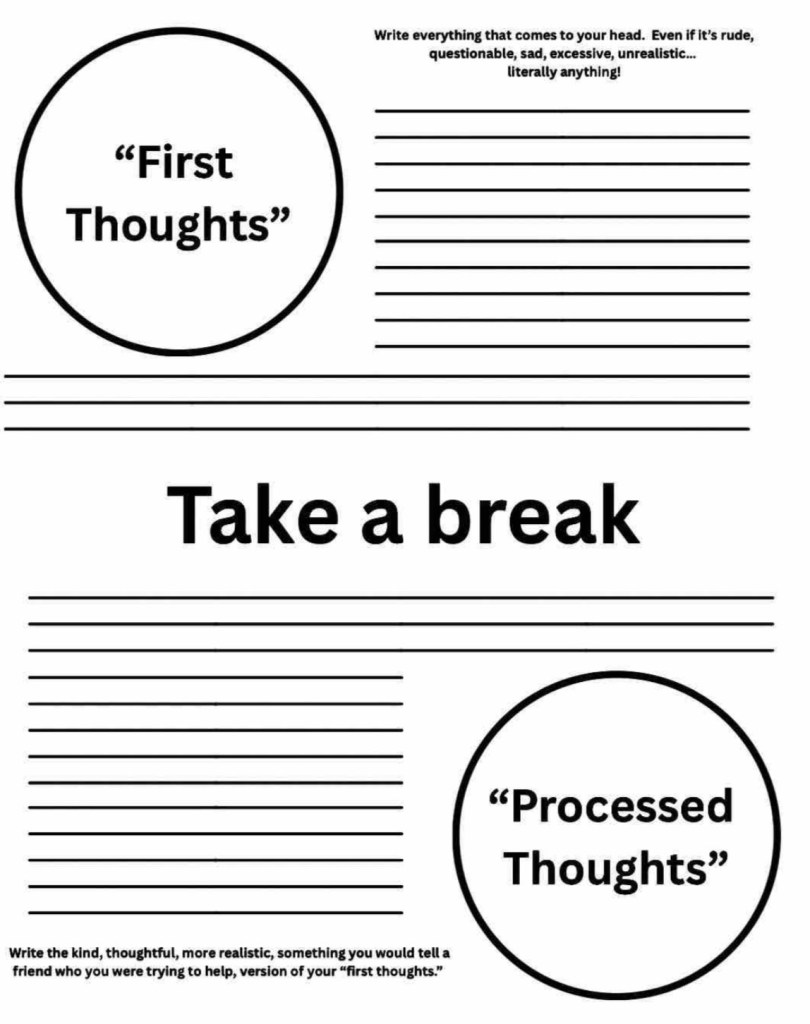
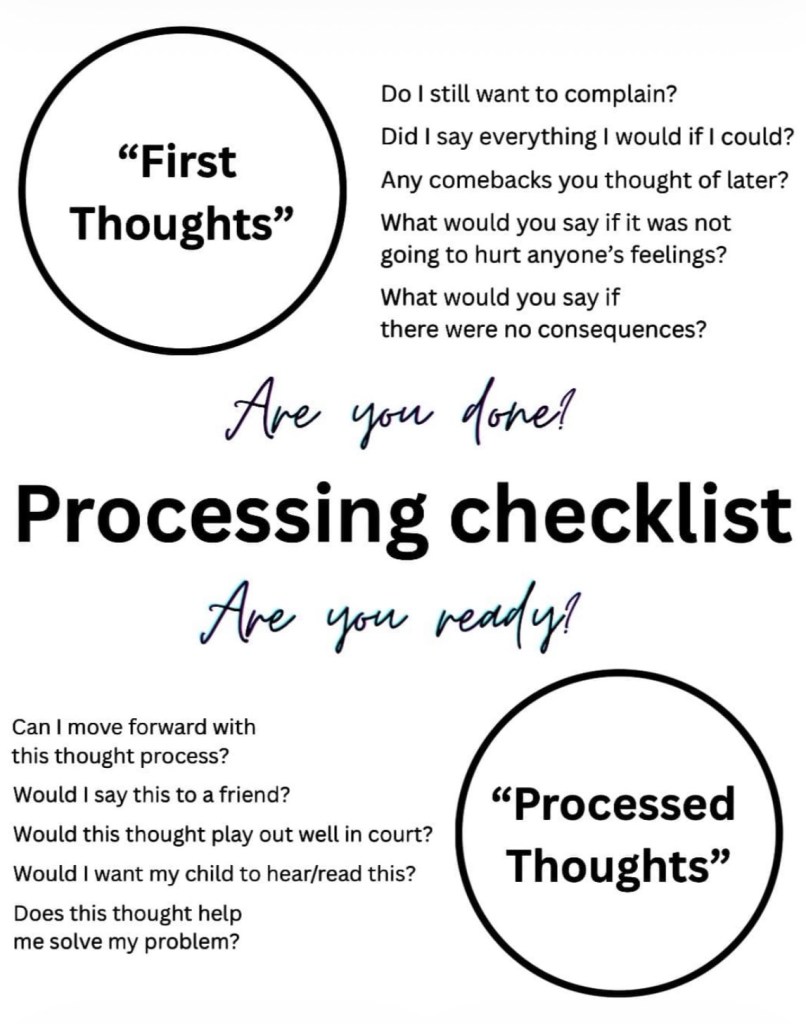
Page one is the space to write. Page two is to help a person figure out where their thoughts currently sit. Are they still in the “First Thoughts” mindset or are they ready to move forward and have more solid “processed thoughts”? The questions aren’t all inclusive, they’re simply a sample to help people decide where they might be. There likely are additional questions that would be just as helpful.
I try to help my clients normalize their first thoughts. I think society has tried to make questionable thoughts seem taboo or like something is wrong with someone. I don’t know a single person in this life who hasn’t had some dark as hell thoughts. It’s normal to feel dark things, what’s not normal is the actions that could follow if you don’t process the thoughts in a healthy way.
*If you are at the point where your thoughts are leading towards dark actions (harming yourself or others) please seek help! Call 988, call 911, follow your safety plan if you have one, or call someone you think will be able to get you help safely!*
Over my years I’ve worked with kids and their parents very closely. I’ve had kids say I don’t think my parents want to be parents. I’ve heard parents say they sometimes wish they weren’t parents. I’ve said those words myself. The facts are, that’s a real feeling! Parenting is crazy hard. We can’t act like it’s not. Sometimes we don’t do the right things as parents. We have to be open with our kids and share that some days being a parent is really hard. Some days we don’t know what we’re doing. I tell my kids that this is the first time we’re parenting y’all, so no, we don’t know if we’re doing the right thing all the time, but we’re trying.
If we are more open and honest with our kids as they grow up, they would likely struggle less with their mental health as well. We try to hide all the struggles and act like we have it all together when our kids need to see that we don’t.
I created this resource to help some of my kid clients, but their parents need it just as much.
Part of my job is helping kids see that they deserve grace, but their parents do as well. Now, don’t get me wrong, adults have had more time to learn better skills, and some behaviors are just not acceptable. There’s no doubt that some parents really gotta get it together. However, has society set them up to be successful?
Probably not.
That’s why I want to put this out in the world. PLEASE take the time to get out those dark/tough/sad/etc thoughts! Process them with someone you trust. It’s preferable that this person is a mental health professional, but I recognize those resources aren’t as accessible for everyone.
I want to be clear that the thoughts I’m describing aren’t just people thinking about things like suicide or homicide.
*A reminder for anyone reading this, talking about suicide does not increase the chances of someone completing a suicide. Talking about it has actually shown to decrease the chances because it opens the door for getting people help!*
The thoughts I’m describing could be anything! Let me give y’all some examples.
- You feel like your sibling gets more attention than you.
- You feel like your spouse focuses more on work than your family.
- Your best friend is moving away.
- You don’t have money to get new pants and all the ones you own have holes in them.
- The government sucks.
- Your parents are getting older and you’re having to process what it’s going to be like when they’re gone.
- You’re about to turn the age where you can start driving and you’re terrified of driving.
- You got accepted into college and you’re worried about what it means when you’re no longer there for your family.
- Your boss was rude as hell at work today.
- The job you have is sucking the life out of you.
- Someone close to you passed away.
- Your children don’t come to visit you as often as you’d like.
- Gas and grocery prices continue to increase.
- You dealt with someone racist today or deal with the effects of systemic racism in general.
- Your family doesn’t support your gender or sexual identity development.
- The daycare your child is going to is suddenly shutting down.
- You watched/read an emotional movie/show/book and are struggling to process your thoughts about it.
- The food you prepared for someone you love didn’t turn out how you hoped it would.
- Your favorite pair of shoes are no longer wearable.
- Your girlfriend/boyfriend broke up with you.
- You have to go visit family that you don’t particularly enjoy visiting.
- You’re having a tough day at a sports or activity practice and are questioning if you want to continue.
- Your parents have rules that make zero sense to you.
- You feel like no one is listening to you.
- You don’t know what you want to do job wise for the potential rest of your life.
- You’re sober but experienced something that makes you consider using again.
- You’re a stepparent feeling like nothing you do will matter because your role is considered less than.
- Your school assignment is confusing and you question your intelligence.
- Someone made a negative comment about how you look.
- You’re dealing with complicated health diagnoses.
I think 30 examples is sufficient. Even the smallest thing can feel big some days. Comparing your issues to someone else’s will never help you solve yours. If it feels big, you gotta deal with it, even if someone else “has it worse”. If we ignore it because “it’s not that serious,” we’re opening ourselves up for our issues to escalate. Not processing emotions leads us closer and closer to things like depression, anxiety, suicidal ideation, and likely more mental and physical health consequences we may not be aware of.
We have to learn how to process our thoughts and teach children how to do the same! I truly hope this blog and the resource I created will help someone out there.
I’ve written numerous times over the years that being a human is hard! I know there any resources and things out there that are readily available and accessible for those struggling. I’m hopeful to be someone that can help make things more accessible for everyone! This life is hard and will always be hard! I’m hopeful I made it a little easier to manage today! I love all you beautiful humans!


Saying the quiet part out loud, journal entries can be mean, dramatic, and ridiculous, normalizes what most journaling advice skips past. The skill framing matters too, overwhelm is not a character flaw, it is a missing tool, and free resources like this lower the barrier for people who cannot start with therapy. The caveat that journaling alone is not everything makes the resource more trustworthy, not less. Does the printable walk through the rewrite step, or leave that open?
LikeLike
Thank you for your comment! It means a lot! There is a small reframe, but definitely a bit more open. I may create something more detailed to go along with it to help with that step! Getting to the point where you can move forward in a healthy way is hard without support! Journaling helps but also having back up from a healthy support system is ideal!
LikeLike